The Mayans may be right. The world may be coming to an end in a few short days.
Maybe, on December 21, everything will cease to exist. Or transform into a whole new realm of matter. Or the world might just change into myriad rainbow colors, and we’ll all ride around in a yellow submarine…no, never mind, that’s a different apocalypse, isn’t it.
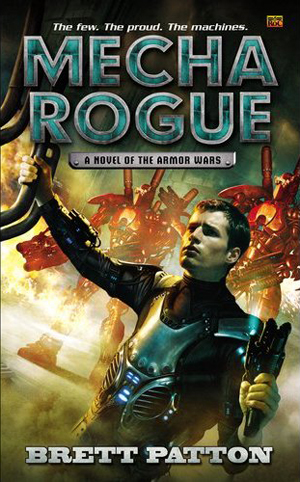
But maybe the world is coming to an end. There’s no other way to explain why Kirkus Reviews decided to take a look at Mecha Rogue, my latest novel under the Brett Patton pseudonym.
Yes, you read that right. Kirkus. Giant robots. Review.
And there’s no other way to explain why, well, the guys are Kirkus seemed to, well, kinda like the book:
In style and violence, a hybrid of the movies Transformers and Independence Day: the sequel to Mecha Corps (2011)…
Slam-bang action with never a dull moment: imagine a 21st century Lensman series, if anybody still remembers E.E. “Doc” Smith, without the latter’s lofty black-and-white moral tone and awful prose.
Yes, that’s right. Mecha Rogue is a New and Notable book on Kirkus Reviews. Check it out!
What’s more, Kirkus decided to talk with me a bit about the Mecha Rogue universe, my writing, and general SF stuffs. You can check out the interview here.
Hey all, just a quick note: I’m a Sidewise Award nominee for the second time!
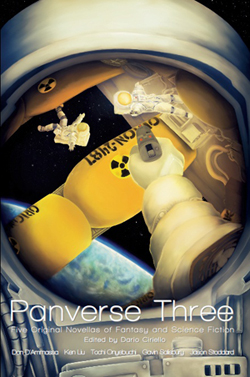
The first was for the Edison-meets-Bill-Gates “Panacea,” published on Sci Fiction. This time it’s for “Orion Rising,” published in Panverse Three.
The Sidewise Awards are dedicated to alternate history. And Orion Rising is definitely an alternate—a look at what might have happened if we’d gotten Orion as our space program, rather than Apollo. After a convo with Freeman Dyson at a conference on the commercialization of space, it didn’t seem that far-fetched.
Here’s the full story:
We are pleased to announce this year’s nominees for the Sidewise Award for Alternate History. The winners will be announced at Chicon 7, this year’s Worldcon, in Chicago, Illinois during the weekend of August 30. The Sidewise Awards have been presented annually since 1995 to recognize excellence in alternate historical fiction. This year’s panel of judges was made up of Stephen Baxter, Evelyn Leeper, Jim Rittenhouse, Stu Shiffman, Kurt Sidaway, and Steven H Silver.
Congratulations and best of luck.
Short Form
* Michael F. Flynn, The Iron Shirts (Tor.com) * Lisa Goldstein, Paradise Is a Walled Garden (Asimov’s, 8/11) * Jason Stoddard, Orion Rising (Panverse 3, edited by Dario Ciriello, Panverse Publishing) * Harry Turtledove, Lee at the Alamo (Tor.com)
Long Form
* Robert Conroy, Castro’s Bomb (Kindle) * Robert Conroy, Himmler’s War (Baen Books) * Jeff Greenfield, Then Everything Changed (Putnam) * Ian R MacLeod, Wake Up and Dream (PS Publishing) * Ian McDonald, Planesrunner (Pyr) * Ekaterina Sedia, Heart of Iron (Prime) * Lavie Tidhar, Camera Obscura (Angry Robot)
Hmm. A new venture plans to put people on Mars by 2023 and wrap a reality show around it.
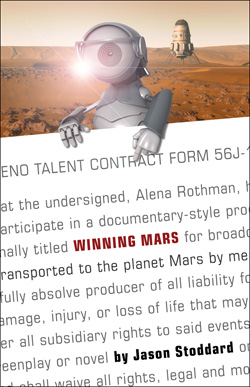
Let’s see. Winning Mars is about a reality show on Mars, and it’s set in the 2021-2023 timeframe. Wonder where they got the idea?
Just kidding. Maybe great minds think alike. Or maybe we’re both crazy. Who knows? I did predict compression spacesuit technology, the ongoing economic downturn, and now reality shows on Mars . . . so if Winfinity shows up soon, well, hmm.
Actually, there’s been a lot of news in commercial space that I missed. SpaceX was part of Winning Mars, but I didn’t predict the asteroid mining venture (with some significant backers.) And the recent news about the successful SpaceX launch to the ISS is mega-cool.
Hats off to the crazy people in the world!
June 6th, 2012 / Comments Off on A Page out of Winning Mars…
Mecha Corps isn’t the only book getting love. Check out what everyone has to say about Winning Mars! And in this case, it may be a deep-seated trope to look at what’s over the next hill . . . after all, we did evolve to walk upright–and thus explore much farther–long before we really had brains. Or at least that’s what they say . . .
“Winning Mars is a fascinating story, thought-provoking and insightful. Stoddard manages to evoke authors like Walter Jon Williams, Ben Bova, and Cory Doctorow as he painstakingly examines every aspect involved in heading to Mars in a future not too far removed from our own time period. Certainly, it’s easy to see how we could go from Here to There, given the way the economy, the government, and the entertainment industry have performed and evolved in recent years.
Moreover, Stoddard actually addresses a question I’ve contemplated for years, something which has become something of a reality recently. If government-funded space programs are falling behind, why not privatize space travel? Why not give Disney and Microsoft and Apple the room to do what’s needed to put a Disneyworld on the Moon and a Hilton in orbit? Stoddard’s suggested plan for making it to Mars and back with the aid of interested sponsors is believable and interesting. Some are in it for the publicity, some for the challenge, some for the potential return.
My final verdict? Winning Mars is a fascinating, entertaining, quite possibly prophetic book, and I had a lot of fun reading it.”
“As I’ve mentioned before, I’m totally over dystopias. Thankfully, then, despite worries at the beginning, the world of Winning Mars isn’t really dystopic. It seems like a real world, with both good and bad aspects to it. IMHO, it is a plausible extrapolation, for the most part, at least from our current vantage point (though undoubtedly in ten years it’ll seem completely off-base).
What I enjoyed most about it was its hopefulness and optimism about humanity. Ultimately, it pleads the need for the human imagination and the drive to go forth, making space for adventure and crazy-eyed idealism, taking chances, exploring, pushing, growing. As a child of Trek, this speaks to my very soul.”
Apparently, I’m not the only one who likes giant robots. Blame it on Johnny Socko, Gundam, and Evangelion. Or blame it on some deep-seated archetype that squats on our consciousness, making it yearn for the unlimited power–no. Wait. Nevermind. That’s way too deep. Let’s have some fun!
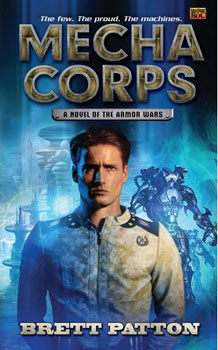
“Mecha Corps by debut novelist Brett Patton is a sci-fi adventure from beginning to end. Once I started reading this story, I could not put this book down. I have a new favorite sci-fi author and his name is Brett Patton. I look forward to reading his other novels in this series, if not any other sci-fi novels he writes.”
Night Owl Reviews, Dawn Colclasure
“Darn good mech action! That pretty well sums up my review of Mecha Corps by Brett Patton. I read a Gundam series awhile back, and the Robotech novels, and Starship Troopers, and Armor. Other science fiction I’ve read has had powered armor in one form or another. They’ve all been good, but Mecha Corps just freakin’ kills it! This book, apparently the start of series called the Armor Wars, is what all mecha fiction should be like.”
Kevin Bayer, Sporadic Reviews
“Brett Patton has written a thrill a minute military science fiction starring a fascinating hero who learns in training to be part of a cohesive unit which requires him to give up for now his personal goal. Readers also observe the politicians who use and sacrifice Black Ops agents to further their ambitions. Filled with twists and secrets that are not all revealed in this action-packed story line, fans will enjoy staring into combat with the Mecha Corps.”
Alternative Worlds, Harriet Klausner
“Mecha Corps is a fun, fast-paced science fiction adventure. With colorful characters and an exciting plot, this story was hard to put down. This first novel in a continuing series show plenty of promise. While this novel is a successful standalone, with a satisfying conclusion, there is plenty of room for more story and a few unanswered questions.”
SciFiChick.com
“Best new release was Brett Patton‘s debut Mecha Corps. It is a promising new military science series with features from Transformers and the Mech Warrior universe.”
Cybermage.se
January 14th, 2012 / Comments Off on Accolades for Mecha Corps
 by Brett Patton. I read a Gundam series awhile back, and the Robotech novels, and Starship Troopers, and Armor. Other science fiction I’ve read has had powered armor in one form or another. They’ve all been good, but Mecha Corps just freakin’ kills it! This book, apparently the start of series called the Armor Wars, is what all mecha fiction should be like.”